

Die Auswahl der richtigen gewerblichen Getränkeautomaten ist nicht einfach eine Frage nach dem Modell mit den meisten Funktionen. Die richtige Lösung hängt von Ihrem Standort, Ihrem Getränkeangebot, dem Kundenaufkommen, der Kapazität des Automaten, Ihren Zahlungsanforderungen sowie Ihren langfristigen Betriebsbedürfnissen ab.
Für Unternehmen, die Kaffee, Proteinsmoothies, Tee, Sprudelwasser oder andere Selbstbedienungsgetränke anbieten möchten, erläutert dieser Leitfaden die sieben entscheidenden Faktoren, die vor dem Kauf eines gewerblichen Getränkeautomaten zu berücksichtigen sind.
Bevor Sie sich für ein Modell entscheiden, prüfen Sie diese sieben Faktoren:
Wo wird der Automat installiert?
Welche Getränke möchten Sie anbieten?
Wie groß muss die Kapazität sein?
Frischgebrühter Kaffee oder pulverbasierte Getränke?
Welche intelligenten Funktionen und Zahlungsoptionen werden benötigt?
Welche Abmessungen hat der Automat, und welche Anforderungen bestehen hinsichtlich Installation und Wartung?
Kann der Lieferant zuverlässige langfristige Unterstützung bieten?
Eine geeignete Maschine sollte dem Geschäftsszenario entsprechen, statt einfach die höchste Funktionsanzahl aufzuweisen.
Die erste Frage lautet nicht „Welche Maschine soll ich kaufen?“, sondern:
Wo wird der Verkaufsautomat eingesetzt?
Unterschiedliche Standorte weisen unterschiedliche Anforderungen an Getränke, Kundenfrequenz, verfügbaren Platz und Betriebsbedingungen auf.
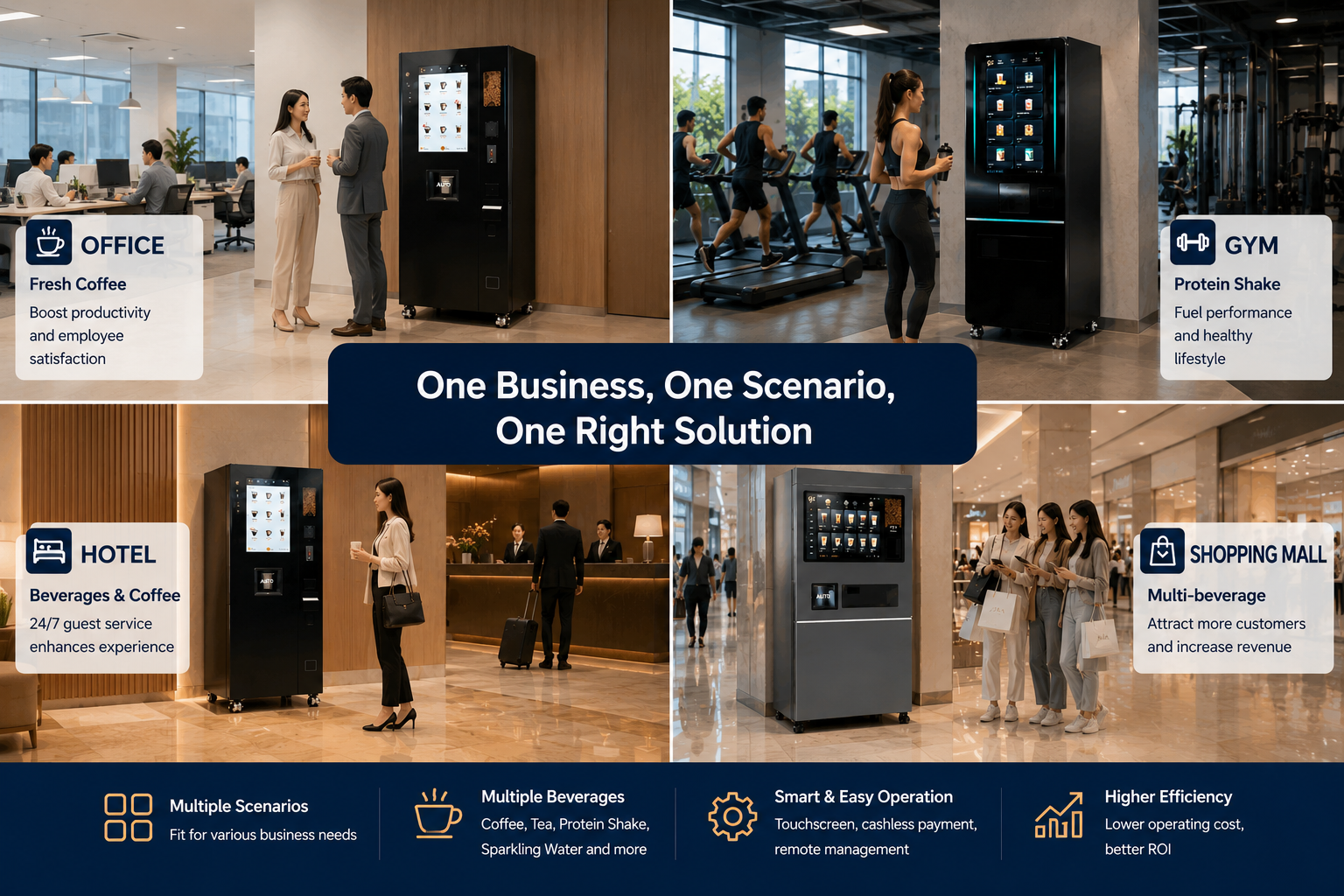
Büroumgebungen benötigen typischerweise bequeme Kaffee- und Getränkeservices für Mitarbeiter und Besucher. Ein Frischkaffee-Automat kann frisch gemahlenen Kaffee bereitstellen, ohne dass eine traditionelle, personell besetzte Kaffeetheke erforderlich ist.
Hotels benötigen möglicherweise ein breiteres Getränkesortiment und flexible Selbstbedienungsoptionen. Ein Multikategorie-Automat kann Kaffee, Tee, Milchtee, Sprudelwasser und andere Getränke in einer einzigen Lösung kombinieren.
Fitness-Einrichtungen haben andere Anforderungen als traditionelle Kaffee-Standorte. Proteinshakes und nahrhafte Getränke sind oft relevanter, weshalb ein spezieller Proteinshake-Automat eine geeignete Option darstellt.
Geschäftliche Umgebungen mit hohem Besucheraufkommen profitieren möglicherweise von Automaten, die mehrere Getränkekategorien anbieten, über eine größere Zutatenkapazität verfügen und integrierte Zahlungs- sowie Fernverwaltungsfunktionen bieten.
Das erste Kaufprinzip ist einfach: Wählen Sie den Automaten anhand des Standorts und der Kundennachfrage – nicht nur nach dessen optischem Erscheinungsbild.
Ihre Getränkekarte gehört zu den wichtigsten Faktoren bei der Auswahl eines Automaten.
Unterschiedliche Automaten sind für unterschiedliche Produktkategorien konzipiert.
| Getränkeanforderung | Passende GS-Verkaufslösung |
|---|---|
| Frischen Kaffee | JK86 / JK88 |
| Kaffee + Tee + Sprudelwasser + Milchtee | JK89 |
| Proteinshakes verbessern | JK91 |
| Mehrere pulvergemischte Getränke | GS805 |
| Unbesetzter Einzelhandel / Sofortkauf | GS520 / GS1100 |
Zum Beispiel, JK88 ist eine frische Bean-to-Cup-Kaffeemaschine, die über mehrere Pulvermischungen mehr als 20 Geschmacksrichtungen unterstützt. Sie verfügt über eine Kapazität von 1,8 kg Kaffeebohnen und fünf 4-Liter-Behälter.
Für Unternehmen, die ein breiteres Getränkesortiment benötigen, JK89 unterstützt frisch gemahlenen Kaffee, frisch gebrühten Tee, Sprudelwasser und Milchtee mit über 200 Geschmackskombinationen durch mehrere Pulvermischungen.
Für Fitnessanwendungen, JK91 ist speziell für Proteinshakes konzipiert, mit neun Pulverfächern und fünf Mischklingen. Sie unterstützt mehr als 50 Geschmackskombinationen und bietet verschiedene Mischmodi für unterschiedliche Pulvertypen.
Eine Maschine, die in einem kleinen Büro gut funktioniert, ist möglicherweise nicht für ein belebtes Einkaufszentrum oder einen Verkehrsknotenpunkt geeignet.
Bevor Sie kaufen, schätzen Sie Folgendes ab:
Täglicher Kundenverkehr
Erwarteter Getränkeumsatz
Verbrauch an Zutaten
Benötigte Becher
Wasserversorgung
Nachfüllhäufigkeit
Verfügbarer Betriebsraum
Zum Beispiel, JK86 hat eine Kaffebohnenkapazität von 1,8 kg, fünf 4-L-Kanister, zwei flüssige Peristaltikpumpen und einen integrierten Eisbereiter. Außerdem sind etwa 300 Pappbecher mit 14 oz Inhalt enthalten.
Für eine kleinere Stellfläche JK88 misst 700 × 760 × 1800 mm und wiegt mindestens 120 kg, bietet aber immer noch eine Kapazität von etwa 300 Bechern.
Der Schlüssel liegt im Ausgleich von Kapazität, Stellfläche und erwarteter Nachfrage anstatt automatisch die größte Maschine auszuwählen.
Ein weiterer wichtiger Aspekt ist das Getränkezubereitungssystem.
Frischkaffee-Automaten mahlen Kaffeebohnen und bereiten Getränke automatisch zu. Sie eignen sich besonders für Unternehmen, die ein hochwertigeres Kaffeeerlebnis anbieten möchten.
Beispielsweise nutzen sowohl der JK86 als auch der JK88 ein frisches Bean-to-Cup-Kaffeesystem. Der JK86 integriert zudem einen Eismacher für Heiß- und Kaltgetränke.
Pulverbasierte Systeme ermöglichen eine breitere Palette an Getränke-Rezepturen und Geschmackskombinationen.
Die GS805 verwendet beispielsweise ein eigenständiges Mischsystem, bei dem zunächst Wasser hinzugefügt und die Zutaten direkt im Becher gemischt werden. Sie unterstützt mehr als 20 Geschmacksrichtungen.
Wenn Ihr Geschäft mehrere Getränkekategorien aus einer einzigen Maschine benötigt, könnte eine All-in-One-Lösung besser geeignet sein.
Die JK89 kombiniert:
Frischer Kaffee + Frischer Tee + Milchtee + Sprudelwasser
Sie unterstützt zudem mehr als 200 Geschmackskombinationen und umfasst Fernbedienung sowie Fernwartungsmanagement.
Moderne gewerbliche Verkaufsautomaten beschränken sich nicht mehr nur auf die Ausgabe von Produkten.
Für B2B-Betreiber können intelligente Funktionen genauso wichtig sein wie das Getränkesystem selbst.
Vergleichen Sie beim Maschinenvergleich, ob sie Folgendes unterstützen:
Touchscreen-Bestellung
Integrierte Zahlungssysteme
Fernbedienung und -verwaltung
Rezept- oder Speisekartenverwaltung
Werbe-Display
Elektronische Schlösser
Verschiedene Zahlungsoptionen
Geplante Betriebszeiten
Das Produktsortiment von GS Vending umfasst Android-basierte Fernverwaltungssysteme sowie integrierte Zahlungsfunktionen bei mehreren Modellen.
Beispielsweise verfügt das Modell JK86 über einen 27-Zoll-LCD-Bildschirm für Werbung und Geschmacksauswahl sowie ein Android-System zur Fernsteuerung.
Das Modell JK89 verfügt über einen 32-Zoll-LCD-Bildschirm und unterstützt Fernbedienung sowie Fernwartungsverwaltung.
Beim Modell JK91 unterstützt das elektronische Schloss sowohl die Software- als auch die Fernentsperrung; zudem sind geplante Betriebszeiten und ein intelligenter Stromzähler als Optionen verfügbar.
Ein gewerblicher Verkaufsautomat muss nicht nur zum Geschäftsmodell, sondern auch zum physischen Installationsort passen.
Vor der Bestellung prüfen Sie:
Zum Vergleich:
JK88: 700 × 760 × 1800 mm
JK91: 700 × 740 × 1900 mm
JK89: 1000 × 860 × 1920 mm
JK86: 1090 × 815 × 1920 mm
Beachten Sie außerdem:
Zugang durch Tueren und Aufzuege
Stromversorgung
Wasserversorgung
Maschinenabstand
Zutatenlagerung
Zugang zum Reinigen
Betriebsbereich des Kunden
Beispielsweise unterstützt der JK89 entweder Pumpenwasser oder Leitungswasser, während der JK86 und der JK88 standardmäßig mit Pumpenwasserversorgung ausgeführt sind und Leitungswasser als Option verfügbar ist.
Die Planung dieser Details vor dem Kauf kann spätere Installationsprobleme vermeiden.
Die Maschine selbst ist nur ein Teil eines erfolgreichen Automatenprojekts.
Für gewerbliche Käufer sollten auch die Fertigungskapazität des Lieferanten, das Produktsortiment, Zertifizierungen und internationale Serviceerfahrung berücksichtigt werden.
Bevor Sie eine Bestellung aufgeben, stellen Sie folgende Fragen:
Verfügt der Lieferant über eigene Fertigungskapazitäten?
Wie lange ist das Unternehmen bereits in der Branche tätig?
Über welche Zertifizierungen verfügen Sie?
Unterstützt der Lieferant internationale Märkte?
Ist technischer Support nach der Installation verfügbar?
Kann der Lieferant Ersatzteile und Verbrauchsmaterialien bereitstellen?
Kann der Lieferant verschiedene Geschäftsszenarien unterstützen?
Kann die Maschine an die Anforderungen des lokalen Marktes angepasst werden?
GS Vending wurde gegründet im 2008und hat sich zu einem Hightech-Unternehmen entwickelt, das Forschung und Entwicklung, Fertigung und Vertrieb integriert. Das Unternehmen betreibt ein 20.000-m²-modernen Fabrik mit einer jährlichen Produktionskapazität von mehr als 30.000 Einheiten . Seine Geräte haben ein tägliches aktives Volumen von mehr als 180.000 Einheiten weltweit , mit mehr als 2.000 Unternehmenskunden und ein Vertriebsnetz, das über 90 Länder und Regionen .
Die Produkte des Unternehmens haben zudem internationale Zertifizierungen erhalten, darunter ETL, CE, CB, FCC, FDA, UL, ROHS, SAA und UKCA .
Verwenden Sie vor der Kaufentscheidung diese Checkliste:
| Kaufkriterium | Fragen stellen |
|---|---|
| Standort | Wo wird der Automat installiert? |
| Getränketyp | Kaffee, Tee, Proteinschake, Sprudelwasser oder mehrere Kategorien? |
| Kundenfrequenz | Wie viele Kunden werden täglich erwartet? |
| Kapazität | Welche Zutaten- und Becherkapazität ist erforderlich? |
| Maschinengröße | Passt das Gerät an den Installationsort? |
| Wasserversorgung | Pumpenwasser oder Leitungswasser? |
| Zahlungsbedingungen | Welche Zahlungsmethoden sind erforderlich? |
| Intelligente Steuerung | Ist eine Fernüberwachung und -verwaltung erforderlich? |
| Wartung | Wie erfolgen Reinigung, Nachfüllung und Wartung? |
| Anbieter | Bietet der Hersteller technischen Support und After-Sales-Service? |
Falls Sie verschiedene kommerzielle Getränkeautomaten vergleichen, kann die folgende Übersicht bei der Auswahl helfen:
| Modell | Hauptgetränk | Schlüsselmerkmal | Typische Anwendung |
|---|---|---|---|
| JK86 | Frischer Kaffee und gemischte Getränke | Frischer Kaffee von der Bohne bis zur Tasse + integrierter Eiswürfelbereiter | Geschäfte mit hohem Kundenverkehr |
| JK88 | Frischer Kaffee und gemischte Getränke | Kompakte Lösung für frischen Kaffee | Büros und Gewerbeflächen |
| JK89 | Kaffee, Tee, Milchtee & Sprudelwasser | Mehrere Kategorien, über 200 Geschmackskombinationen | Hotels, Einkaufszentren und vielfältige Getränkestätten |
| JK91 | Proteinshake | 9 Pulverfächer + 5 Mischklingen | Fitnessstudios und Sportzentren |
| GS805 | Pulvergemischte Getränke | Unabhängiges Mischen direkt in der Tasse | Hotels, Büros und Kantinen |
Die beste Maschine ist letztlich diejenige, die zu Ihrer getränkekarte, Ihrem Standort, der Kundennachfrage und Ihrem Betriebsmodell passt .
Es gibt keine einzige beste Maschine für jedes Geschäft. Die richtige Wahl hängt vom Getränktyp, vom Standort, vom Kundenverkehr, von der erforderlichen Kapazität und vom verfügbaren Platz ab. Ein frischer Kaffeeautomat kann beispielsweise für ein Büro geeignet sein, während ein Protein-Shake-Automat besser zu einem Fitnessstudio passt.
Beginnen Sie damit, Ihren Standort und Ihre Getränkeanforderungen zu definieren. Vergleichen Sie dann die Maschinenkapazität, die Abmessungen, die Zahlungssysteme, die Smart-Management-Funktionen, die Wasserversorgung und den Support des Lieferanten.
Ein spezieller Protein-Shake-Automat kann eine geeignete Option für Fitnessstudios und Fitnesseinrichtungen sein. Der JK91 von GS Vending ist speziell für Protein-Shakes konzipiert und verfügt über neun Pulverfächer, fünf Mischmesser sowie mehr als 50 Geschmackskombinationen.
Frischkaffee-Automaten verwenden Kaffeebohnen zur Zubereitung von Kaffeegetränken, während pulverbasierte Systeme vorgemischte Zutaten nutzen, um verschiedene Getränke-Rezepte herzustellen. Die geeignete Wahl hängt von der gewünschten Getränkekarte und dem Geschäftsmodell ab.
Ja. Einige kommerzielle Getränkeautomaten sind für mehrere Getränkekategorien konzipiert. Zum Beispiel unterstützt der JK89 frisch gemahlenen Kaffee, frisch gebrühten Tee, Sprudelwasser und Milchtee in einem einzigen Gerät.
Prüfen Sie die Abmessungen des Geräts, den verfügbaren Platz, die Stromversorgung, die Wasserversorgung, den Zugang für Lieferung und Wartung, die Lagerung der Zutaten sowie den Kundenbetriebsbereich.
Fernverwaltung kann Betreibern helfen, Maschinen zu überwachen und zu steuern, ohne physisch an jedem Standort anwesend sein zu müssen. Mehrere GS-Vending-Modelle umfassen Android-basierte Fernverwaltungs- oder Fernbedienungs- und Wartungsfunktionen.
Achten Sie auf Fertigungskapazität, Produkterfahrung, internationale Zertifizierungen, technischen Support, Verfügbarkeit von Ersatzteilen sowie Erfahrung im Service für unterschiedliche Märkte und Anwendungen.
Der Kauf eines kommerziellen Getränkeautomaten sollte als eine geschäftliche Lösung strategische Investition
Betrachtet werden, nicht lediglich als Geräteanschaffung.
Mit mehr als 18 Jahren Branchenerfahrung , ein 20.000 m² große Produktionsstätte ,30.000+ Einheiten jährliche Produktionskapazität , und ein Vertriebsnetzwerk, das über 90 Länder und Regionen gS Vending bietet kommerzielle Lösungen für frischen Kaffee, Getränke, Proteinshakes und intelligenten Selbstbedienungs-Einzelhandel .
Ob Sie ein Verkaufsautomatenbetreiber, ein Distributor, ein Fitnessstudioinhaber, ein Hotelbetreiber, ein Einzelhändler oder ein Anbieter von Unternehmensdienstleistungen sind – GS Vending hilft Ihnen dabei, eine geeignete Getränkeautomatenlösung für Ihren Markt zu identifizieren.
Kaffee · Getränke · Protein-Shake · Intelligenter Einzelhandel
GS Vending – Werte für Kunden schaffen, Werte für uns selbst verwirklichen.
 EN
EN
 AR
AR
 BG
BG HR
HR
 CS
CS
 DA
DA
 NL
NL
 FI
FI FR
FR
 DE
DE EL
EL
 HI
HI
 IT
IT JA
JA
 KO
KO
 NO
NO PL
PL PT
PT RO
RO
 RU
RU
 ES
ES
 SV
SV
 TL
TL
 ID
ID
 SR
SR
 VI
VI
 HU
HU
 MT
MT
 TH
TH
 TR
TR
 FA
FA
 MS
MS
 GA
GA
 BE
BE
 BN
BN
 LO
LO
 LA
LA
 NE
NE
 MY
MY


